
|
Size: 9736
Comment:
|
Size: 9331
Comment: Updating CoP according to SC decisions on march 2026
|
| Deletions are marked like this. | Additions are marked like this. |
| Line 3: | Line 3: |
| All transactions will be carried out between the Interbull Centre and participating organizations. | All transactions will be carried out between the Interbull Centre and participating NGECs. |
| Line 5: | Line 5: |
| ==== 4.1 Each participating organization will be responsible for: ==== 4.1.1 Checking the quality of national data described below (item 7.1) before sending them to the Interbull Centre, using appropriate protocols including, but not limited to, verification tools provided by the Centre, and communicating explanations for inconsistencies discovered when data is sent. The participating organization is also responsible for correcting (minor) errors in the data, such as file format problems, in cooperation with the Interbull Centre (item 4.2.1). |
|
| Line 8: | Line 6: |
| 4.1.2 Submitting data to Interbull for inclusion in a test evaluation run before entering the evaluation scheme for the first time and before major changes in national evaluations (either methodology or logistics, processing and storage of data) are introduced. | |
| Line 10: | Line 7: |
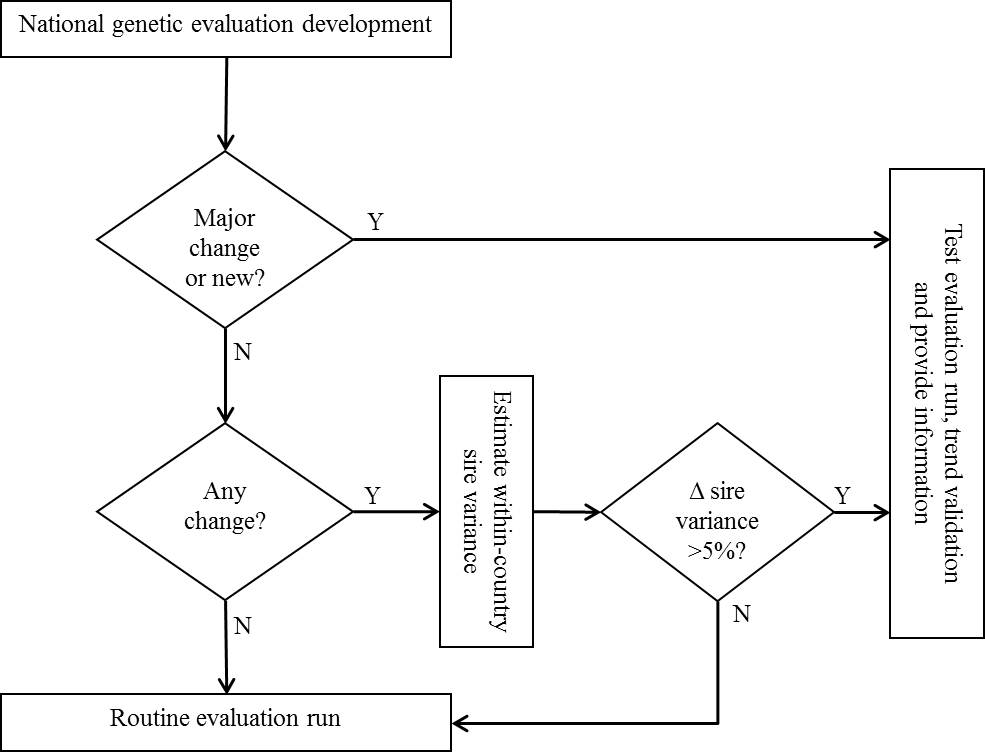
| Modified trait definitions, modified models or genetic parameters in breeding value predictions, and modification of pre-adjustment factors, such as for age, are examples of major changes that require participation in a test evaluation run. Modifications of the database, computer programme or compiler, or conversion criterion are examples of changes that may be considered as “minor”, but that may still create “major” differences in results and thus require participation in a test evaluation run. Changes in within‑country sire variance estimates (based on data included in the international evaluation) larger than 5% from one evaluation to the next cannot usually be explained by added information from young bulls, and may be used as an indication that a test evaluation run is required. | ==== 4.1 Each participating NGEC will be responsible for: ==== 4.1.1 Checking the quality of national data described below (item 7.1.1) before sending them to the Interbull Centre, using appropriate protocols including, but not limited to, verification tools provided by the Centre, and communicating explanations for inconsistencies discovered when data is sent. The participating NGEC is also responsible for correcting (minor) errors in the data, such as file format problems, in cooperation with the Interbull Centre (item 4.2.1). 4.1.2 Submitting data to Interbull Centre for inclusion in a test evaluation run before entering the evaluation scheme for the first time and/or before major changes in national evaluations (either methodology or logistics, processing and storage of data) are introduced. Modified trait definitions, modified models or genetic parameters in breeding value predictions, and modification of pre-adjustment factors, such as for age or extra routinely pedigree updates, are examples of major changes that require participation in a test evaluation run. Modifications of the database, computer programme or compiler, or conversion criterion are examples of changes that may be considered as “minor”, but that may still create “major” differences in results and thus require participation in a test evaluation run. Changes in within‑country sire variance estimates (based on data included in the international evaluation) larger than 5% from one evaluation to the next cannot usually be explained by added information from young bulls, and may be used as an indication that a test evaluation run is required. |
| Line 14: | Line 16: |
| Partecipation in a test evaluation run with modified data implies that an official implementation of the modification is targeted for a near future, usually within 6 months. | Partecipation in a test evaluation run with modified data implies that an official implementation of the modification is targeted for the near future, usually within 6 months. |
| Line 16: | Line 18: |
| 4.1.3 Providing accurate and complete information about national genetic and genomic evaluations using the appropriate forms ([[https://wiki.interbull.org/public/CoP_AppendixII?action=print|Appendix II]]) before entering the evaluation scheme for the first time and when changes in national evaluations are introduced. | 4.1.3 Providing accurate and complete information about national genetic and genomic evaluations using the appropriate forms available in the PREP database (https://prep.interbull.org/) before entering the evaluation scheme for the first time and when changes in national evaluations are introduced. |
| Line 18: | Line 20: |
| 4.1.4 Validating the estimation of genetic trend and genomic validation test (GEBV test) from the national evaluation, following the procedures in [[https://wiki.interbull.org/public/CoP_AppendixIII?action=print|Appendix III]] and [[https://wiki.interbull.org/public/CoPAppendixVIII?action=print|Appendix VIII]]. Trends should be validated: | 4.1.4 Validating the estimation of genetic/genomic trend from the national evaluation, following the procedures in [[https://interbull.org/ib/cop_appendix2|Appendix III]] and [[https://interbull.org/ib/cop_appendix8|Appendix VIII]]. Trends should be validated: |
| Line 20: | Line 22: |
| a) once before the country enters the national evaluation system for the first time, | a) If the NGEC enters the national evaluation system for the first time, |
| Line 22: | Line 24: |
| b) once every second year, | b) If validation results are older than two years, |
| Line 32: | Line 34: |
| 4.1.6 Annually providing Interbull with a summary of their publication policy (using form PUB; [[https://wiki.interbull.org/public/CoP_AppendixII?action=print|Appendix II]]) and publication dates. These will be collated by the Interbull Centre and made available to all countries with the understanding that this does not provide permission for publication of results on the scale and base of another country. | 4.1.6 Annually providing Interbull Centre with a summary of their publication policy and publication dates. These will be collected by Interbull Centre and made publicly available with the understanding that this does not provide permission for publication of results on the scale and base of another country. |
| Line 34: | Line 36: |
| 4.1.7 Distributing and publishing international evaluation results to appropriate agencies at the national level, upon receiving pertinent files from the Interbull Centre (item 7.2.8). | 4.1.7 Distributing and publishing international evaluation results to appropriate agencies at the national level, upon receiving pertinent files from the Interbull Centre (item 7.2.7). |
| Line 36: | Line 38: |
| 4.1.8 Access the international bull pedigree file (item 7.2.7) at the Interbull FTP server, carefully examine bulls and pedigree identified with their country code, and solve any dual-registered bulls or discrepancies directly in the IDEA database. It is advised that records for all bulls identified with their country code are provided in the pedigree and national dairy-production file (item 7.1.2, 7.1.3 and 7.1.4) submitted to Interbull for the next evaluation. | 4.1.8 Access the international bull pedigree file (item 7.2.6) at the Interbull FTP server, carefully examine bulls and pedigree identified with their country code, and solve any dual-registered bulls or discrepancies directly in the IDEA database. It is advised that records for all bulls identified with their country code are provided in the pedigree (item 7.1.2) submitted to Interbull for the next evaluation. |
| Line 42: | Line 44: |
| 4.1.11 Notifying the Interbull Centre regarding any anticipated future changes in the national evaluation system, including new definition of the reference base, and changes in national identification systems. | 4.1.11 Notifying the Interbull Centre regarding any anticipated future changes in the national evaluation system, including new definition of the reference base, and changes in national identification systems at their earliest opportunity. |
| Line 46: | Line 48: |
| 4.1.13 Respecting the confidentiality of the pre-release of international evaluation results (item 7.3.1). | 4.1.13 Respecting the confidentiality of the pre-release of international evaluation results (item 7.3.3). |
| Line 49: | Line 51: |
| 4.2.1 Checking data received from each participating organization and reporting potential errors and/or inconsistencies discovered back to individual organizations; excluding data from the international evaluations if errors or inconsistencies are not corrected before the deadline for receiving data (item 7.3.2) is reached; excluding data from routine international evaluations when data deviate more than expected from previous evaluation, e.g. based on changes in within‑country sire variance estimate (item 4.1.2). | 4.2.1 Checking data received from each participating NGEC and reporting potential errors and/or inconsistencies discovered back to individual NGECs; excluding data from the international evaluations if errors or inconsistencies are not corrected before the deadline for receiving data (item 7.3.2) is reached; excluding data from routine international evaluations when data deviate more than expected from previous evaluation, e.g. based on changes in within‑country sire variance estimate (item 4.1.2). |
| Line 51: | Line 53: |
| 4.2.2 Screening validation results from participating organizations and implementing own validation procedures (Appendix III). | 4.2.2 Screening validation results from participating NGECs and implementing own validation procedures ([[http://interbull.org/ib/cop_appendix2|Appendix III]]). |
| Line 53: | Line 55: |
| 4.2.3 Assessing data connectedness each time a new country joins the scheme. | 4.2.3 Assessing data connectedness each time a new service user joins the scheme. |
| Line 55: | Line 57: |
| 4.2.4 Conducting test evaluation runs according to the approved schedule (item 7.3.1) investigating major changes in the national evaluation methodology of a country, new breeds and/or traits or new countries entering the scheme, and potential improvements in the international genetic evaluation procedure. Results from test runs will be reviewed by technical representatives of all participating countries prior to incorporation into routine evaluations. Results from test runs are confidential. Genetic evaluation results of individual bulls should not become available outside the official Interbull member representative’s genetic evaluation unit in the participating country. Summary statistics may be shared with relevant advisory groups, in order to prepare for incorporation into routine evaluations, but confidentiality of results must always be maintained and no information may be shared that can be of competitive advantage'''.''' | 4.2.4 Conducting test evaluation runs according to the approved schedule (item 7.3.1) investigating major changes in the national evaluation methodology of a NGEC, new breeds and/or traits or new service users entering the scheme, and potential improvements in the international genetic evaluation procedure. Results from test runs will be reviewed by technical representatives of all participating NGECs prior to incorporation into routine evaluations. |
| Line 57: | Line 59: |
| 4.2.5 Conducting routine international evaluations according to the approved schedule (item 7.3.1) and the method approved by the Interbull Steering Committee (item 5) utilizing the most recent correct national evaluation results available from the participating organization. | Results from test runs are confidential. Genetic evaluation results of individual bulls should not become available outside the official Interbull member representative’s NGECs. Summary statistics may be shared with relevant advisory groups, in order to prepare for incorporation into routine evaluations, but confidentiality of results must always be maintained and no information may be shared that can be of competitive advantage'''.''' |
| Line 59: | Line 61: |
| 4.2.6 Timely sending results from the international evaluations to participating organizations in the agreed format and media (item 7.2) together with a description of the method and keys to interpretation of the results. | 4.2.5 Conducting routine international evaluations according to the approved schedule (item 7.3.1) and the methods approved by the Interbull Steering Committee (item 5) utilizing the most recent correct national evaluation results available from the participating NGECs (item 7.3.2). |
| Line 61: | Line 63: |
| 4.2.7 Timely sending results from the international evaluation to countries that do not participate with national data, but meet the prerequisites stated in item 3. | 4.2.6 Timely sending results from the international evaluations to participating NGECs in the agreed format and media (item 7.2.1) together with a description of the method and keys to interpretation of the results. |
| Line 70: | Line 72: |
| 4.3.4 Authorize specific agreements (contracts) between the Interbull Centre and ICAR member and/or participating organizations and/or international societies. | 4.3.4 Authorize specific agreements (contracts) between the Interbull Centre and ICAR member and/or participating NGECs and/or breed societies. |
| Line 72: | Line 74: |
| 4.3.5 Resolve any problem between the Interbull Centre and a participating organization, or any other collaborating partner, which is not resolved directly by the parties involved. | 4.3.5 Resolve any problem between the Interbull Centre and a participating NGEC, or any other collaborating partner, which is not resolved directly by the parties involved. |
| Line 75: | Line 77: |
| 4.4.1 Identify and review technical steps that need to be taken to ensure that an efficient service of high quality is delivered to countries participating in the international genetic evaluations provided by Interbull and to support the continuous development of the service. | 4.4.1 Identify and review technical steps that need to be taken to ensure that an efficient service of high quality is delivered to NGECs participating in the international genetic evaluations provided by Interbull and to support the continuous development of the service. |
| Line 82: | Line 84: |
| Participation in evaluations provided by the Interbull Centre is voluntary and the Interbull Centre and its employees, the Interbull Steering Committee, and/or the Interbull Technical Committee can therefore not be held responsible for financial, or other, damages that may be experienced by anyone utilizing the information contained in reports, listings of international evaluations, and other documents provided as a result of international genetic evaluations. In all events, the maximum liability is equivalent to one annual service fee for the participating organization involved. The Swedish law, applicable to the operations of the Interbull Centre, applies to cases of conflict. | Participation in evaluations provided by the Interbull Centre is voluntary and the Interbull Centre and its employees, the Interbull Steering Committee, and/or the Interbull Technical Committee can therefore not be held responsible for financial, or other, damages that may be experienced by anyone utilizing the information contained in reports, listings of international evaluations, and other documents provided as a result of international genetic evaluations. In all events, the maximum liability is equivalent to one annual service fee for the participating NGECs involved. The Swedish law, applicable to the operations of the Interbull Centre, applies to cases of conflict. |
4. Interbull CoP - Responsibilities
All transactions will be carried out between the Interbull Centre and participating NGECs.
4.1 Each participating NGEC will be responsible for:
4.1.1 Checking the quality of national data described below (item 7.1.1) before sending them to the Interbull Centre, using appropriate protocols including, but not limited to, verification tools provided by the Centre, and communicating explanations for inconsistencies discovered when data is sent. The participating NGEC is also responsible for correcting (minor) errors in the data, such as file format problems, in cooperation with the Interbull Centre (item 4.2.1).
4.1.2 Submitting data to Interbull Centre for inclusion in a test evaluation run before entering the evaluation scheme for the first time and/or before major changes in national evaluations (either methodology or logistics, processing and storage of data) are introduced.
Modified trait definitions, modified models or genetic parameters in breeding value predictions, and modification of pre-adjustment factors, such as for age or extra routinely pedigree updates, are examples of major changes that require participation in a test evaluation run. Modifications of the database, computer programme or compiler, or conversion criterion are examples of changes that may be considered as “minor”, but that may still create “major” differences in results and thus require participation in a test evaluation run. Changes in within‑country sire variance estimates (based on data included in the international evaluation) larger than 5% from one evaluation to the next cannot usually be explained by added information from young bulls, and may be used as an indication that a test evaluation run is required.
The procedural steps are graphically illustrated in Figure 4.1, below.
Partecipation in a test evaluation run with modified data implies that an official implementation of the modification is targeted for the near future, usually within 6 months.
4.1.3 Providing accurate and complete information about national genetic and genomic evaluations using the appropriate forms available in the PREP database (https://prep.interbull.org/) before entering the evaluation scheme for the first time and when changes in national evaluations are introduced.
4.1.4 Validating the estimation of genetic/genomic trend from the national evaluation, following the procedures in Appendix III and Appendix VIII. Trends should be validated:
a) If the NGEC enters the national evaluation system for the first time,
b) If validation results are older than two years,
c) when changes in the national evaluations (methodology or data) are made that require partecipation in a test evaluation run.
Fig. 4.1 Graphical represenation of Interbull actions:
4.1.5 Timely sending national evaluation data files for all actual breeds and traits to the Interbull Centre in the agreed format and media.
4.1.6 Annually providing Interbull Centre with a summary of their publication policy and publication dates. These will be collected by Interbull Centre and made publicly available with the understanding that this does not provide permission for publication of results on the scale and base of another country.
4.1.7 Distributing and publishing international evaluation results to appropriate agencies at the national level, upon receiving pertinent files from the Interbull Centre (item 7.2.7).
4.1.8 Access the international bull pedigree file (item 7.2.6) at the Interbull FTP server, carefully examine bulls and pedigree identified with their country code, and solve any dual-registered bulls or discrepancies directly in the IDEA database. It is advised that records for all bulls identified with their country code are provided in the pedigree (item 7.1.2) submitted to Interbull for the next evaluation.
4.1.9 Acknowledging the role of the Interbull Centre on the computation of international evaluations whenever these are published and used.
4.1.10 Paying the agreed fees within 30 days after invoices are issued (item 10).
4.1.11 Notifying the Interbull Centre regarding any anticipated future changes in the national evaluation system, including new definition of the reference base, and changes in national identification systems at their earliest opportunity.
4.1.12 Respecting the confidentiality of results from test evaluation runs (item 4.2.4).
4.1.13 Respecting the confidentiality of the pre-release of international evaluation results (item 7.3.3).
4.2 The Interbull Centre is responsible for:
4.2.1 Checking data received from each participating NGEC and reporting potential errors and/or inconsistencies discovered back to individual NGECs; excluding data from the international evaluations if errors or inconsistencies are not corrected before the deadline for receiving data (item 7.3.2) is reached; excluding data from routine international evaluations when data deviate more than expected from previous evaluation, e.g. based on changes in within‑country sire variance estimate (item 4.1.2).
4.2.2 Screening validation results from participating NGECs and implementing own validation procedures (Appendix III).
4.2.3 Assessing data connectedness each time a new service user joins the scheme.
4.2.4 Conducting test evaluation runs according to the approved schedule (item 7.3.1) investigating major changes in the national evaluation methodology of a NGEC, new breeds and/or traits or new service users entering the scheme, and potential improvements in the international genetic evaluation procedure. Results from test runs will be reviewed by technical representatives of all participating NGECs prior to incorporation into routine evaluations.
Results from test runs are confidential. Genetic evaluation results of individual bulls should not become available outside the official Interbull member representative’s NGECs. Summary statistics may be shared with relevant advisory groups, in order to prepare for incorporation into routine evaluations, but confidentiality of results must always be maintained and no information may be shared that can be of competitive advantage.
4.2.5 Conducting routine international evaluations according to the approved schedule (item 7.3.1) and the methods approved by the Interbull Steering Committee (item 5) utilizing the most recent correct national evaluation results available from the participating NGECs (item 7.3.2).
4.2.6 Timely sending results from the international evaluations to participating NGECs in the agreed format and media (item 7.2.1) together with a description of the method and keys to interpretation of the results.
4.3 The responsibilities of the Interbull Steering Committee with reference to the Interbull Centre are to:
4.3.1 Define the general objectives of the Interbull Centre.
4.3.2 Approve new or major modifications of existing services offered by the Interbull Centre upon recommendation from the Interbull Technical Committee.
4.3.3 Approve annual budgets and work plans.
4.3.4 Authorize specific agreements (contracts) between the Interbull Centre and ICAR member and/or participating NGECs and/or breed societies.
4.3.5 Resolve any problem between the Interbull Centre and a participating NGEC, or any other collaborating partner, which is not resolved directly by the parties involved.
4.4 The responsibilities of the Interbull Technical Committee are to:
4.4.1 Identify and review technical steps that need to be taken to ensure that an efficient service of high quality is delivered to NGECs participating in the international genetic evaluations provided by Interbull and to support the continuous development of the service.
4.4.2 Make decisions on methodological issues that may impact evaluation results, but not strategic directions. Examples would include adoption of a proven better algorithm for parameter estimation, or phantom parent group allocation methods.
4.4.3 Make recommendations to the Interbull Steering Committee on methodological issues of such importance that they may affect the service as a whole. Examples would include adding or removing traits from the evaluation, changing editing criteria, or adopting an entirely new method for genetic/genomic evaluation calculation.
4.5 Disclaimer:
Participation in evaluations provided by the Interbull Centre is voluntary and the Interbull Centre and its employees, the Interbull Steering Committee, and/or the Interbull Technical Committee can therefore not be held responsible for financial, or other, damages that may be experienced by anyone utilizing the information contained in reports, listings of international evaluations, and other documents provided as a result of international genetic evaluations. In all events, the maximum liability is equivalent to one annual service fee for the participating NGECs involved. The Swedish law, applicable to the operations of the Interbull Centre, applies to cases of conflict.